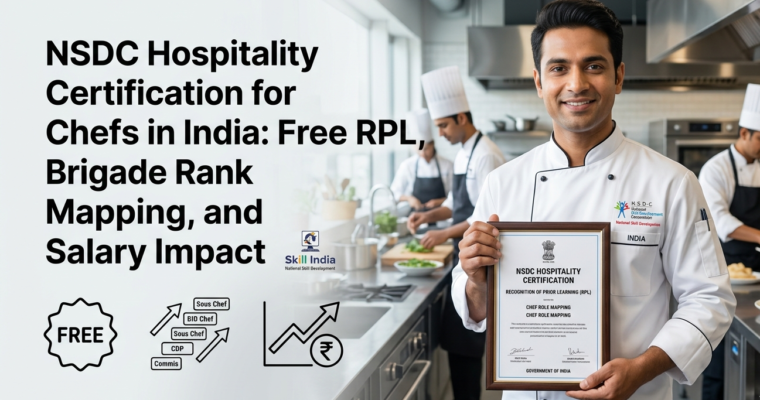
1. The Most Important Thing First — NSDC Certification Is Free for Working Chefs
If you are a working kitchen professional in India and you have heard about NSDC certification but assumed it costs money — this is the article that corrects that assumption. NSDC Hospitality certification via the RPL (Recognition of Prior Learning) pathway under the PMKVY scheme is completely free for working chefs. There is no course fee. You attend a 12-hour orientation and pass an assessment based on your existing kitchen experience. On passing, you receive an official NSDC/THSC certificate plus a ₹500 payout from PMKVY. This is the most underutilised career tool in India’s professional kitchen industry.
| FEATURED SNIPPET BLOCK — NSDC Certification Cost and ProcessCOST: Rs.0 (zero) under PMKVY RPL — no fee charged to the candidate.PAYOUT: Rs.500 paid to the candidate on passing the assessment.PROCESS: Enroll via THSC empanelled training partner → 12-hour orientation → assessment → certificate.WHICH LEVEL: Commis Chef = NSQF Level 3 | CDP = NSQF Level 4 | Sous Chef = NSQF Level 5VALID FOR: Government-recognized credential under NSQF — accepted by hotel chain HR.WHERE TO START: thsc.in → Recognition of Prior Learning |
2. NSDC, NSQF, and THSC — What Each Term Actually Means for Kitchen Staff
Four terms get used interchangeably in conversations about hospitality certification in India. Here is what each one means and how they connect.
| Term | Full Form | What It Is | Relevance to Kitchen Staff |
| NSDC | National Skill Development Corporation | Government-backed body that funds and coordinates skill development across all sectors in India | The parent organisation — NSDC provides the funding and framework but does not directly certify kitchen staff |
| THSC | Tourism & Hospitality Skill Council | The specific Sector Skill Council under NSDC that governs all tourism and hospitality certifications | THSC issues your certificate. When you see “NSDC hospitality certification” — this is actually a THSC-issued credential under the NSDC framework |
| NSQF | National Skills Qualification Framework | The 8-level qualification framework (Level 1 = entry, Level 8 = expert) that all NSDC certifications are pegged to | Your level depends on your brigade rank. Commis = Level 3, CDP = Level 4, Sous Chef = Level 5 |
| RPL | Recognition of Prior Learning | The process by which THSC certifies skills you already have through work experience — without requiring a full course | The pathway working chefs use. You do not redo basic training. You demonstrate existing competence and get certified. |
| PMKVY | Pradhan Mantri Kaushal Vikas Yojana | The Government of India scheme that funds free skill certification including RPL | PMKVY pays for your certification under RPL — this is why it is free and why you receive Rs.500 on passing |
| QP / NOS | Qualification Pack / National Occupational Standards | The specific skill standards document that defines what you are assessed on for each job role | Each kitchen role (Commis Chef, CDP, Sous Chef) has its own QP with defined competency standards |
3. NSQF Levels Mapped to Brigade Rank — Which Certification You Need
This is the table that no government portal or training institute website publishes. Every brigade rank in India’s kitchen hierarchy corresponds to a specific NSQF level. Here is the complete mapping.
| Brigade Rank | NSQF Level | THSC Qualification Pack Name | Entry Requirement | Pass Mark | Monthly Salary Differential After Cert |
| Kitchen Helper / Trainee | NSQF Level 2 | Kitchen Steward / Food Production Helper | No minimum — entry level | 50% | Rs.1,000–Rs.2,000 salary review leverage |
| Commis Chef Grade 3–1 | NSQF Level 3 | Commis Chef (Multi Cuisine Cook) | Basic kitchen experience (RPL eligible after 6 months) | 50% | Rs.2,000–Rs.3,000 immediate increment at next review |
| Chef de Partie (CDP) | NSQF Level 4 | Chef de Partie / Advanced Cook | Commis-level experience (RPL eligible after 2 years) | 70% | Rs.4,000–Rs.6,000 negotiation advantage at CDP level |
| Sous Chef | NSQF Level 5 | Food Production Supervisor / Sous Chef | CDP experience (RPL eligible after 4 years total) | 70% | Rs.8,000–Rs.12,000 monthly differential — strongest single salary lever |
| Head Chef / Executive Chef | NSQF Level 6 | Food Production Manager | Sous Chef experience required | 70% | Management-level credential — supports Executive Chef salary band |
★ NSQF Level 5 (Sous Chef) is the single most valuable certification for career advancement. At CDP-to-Sous Chef transition, hotel chain HR explicitly references NSQF Level 5 during salary band discussions. [LINK-2: See full salary impact by rank →]
★ The pass mark increases at Level 4 and above — 70% required for CDP and Sous Chef assessments vs 50% for Commis level. Prepare accordingly. [LINK-4: Understanding the brigade rank system →]
4. Qualification Packs for Kitchen Roles — What Is Actually Assessed
Each THSC Qualification Pack (QP) defines the specific competencies you are assessed on. Here is what working kitchen chefs are evaluated on at each level.
| NSQF Level | QP Name | Core Assessment Areas (70% weightage) | Non-Core Areas (30% weightage) |
| Level 3 — Commis Chef | Multi Cuisine Cook / Commis Chef | Basic food production techniques, mise en place, station hygiene, personal hygiene, safe food handling, basic knife skills, portion control | FSSAI basics, team communication, waste management, energy conservation |
| Level 4 — Chef de Partie | Advanced Cook / Chef de Partie | Advanced food production across multiple cuisines, section management, quality control, recipe standardisation, food cost awareness, junior staff supervision | Customer communication, inventory basics, equipment maintenance, workplace safety |
| Level 5 — Sous Chef | Food Production Supervisor | Kitchen operations management, food safety management system, HACCP awareness, financial controls and food cost, team leadership, menu planning input, procurement coordination | HR basics, vendor communication, crisis management in kitchen, training of juniors |
★ You are assessed on what you already do every day. The QP for Commis Chef tests station rotation skills, mise en place, and hygiene — not advanced techniques. The QP for Sous Chef tests management and HACCP awareness — not advanced cooking. The assessment is designed to recognise existing professional competence, not test aspirational skills.
5. How to Get NSDC Certified as a Working Chef — RPL Step-by-Step
The RPL process through THSC has five stages. Here is each stage with exactly what you need to do.
| Step | Stage Name | What Happens | Your Action | Time Required |
| 1 | Mobilisation | THSC-empanelled training partners or employers announce RPL camps. Hotels can host RPL at the property. | Find an RPL camp via thsc.in → Recognition of Prior Learning → or ask your hotel HR if a camp is scheduled. | 1 day to find and register |
| 2 | Counselling and Pre-Screening | Training partner counsels you on PMKVY, what RPL means, and which QP/level matches your experience. Pre-screening test and document collection. | Bring: Aadhaar card, bank account details, current employment proof or work experience documents. Self-assessment form. | Half day |
| 3 | Orientation | Mandatory 12-hour orientation (can be split over 2 days). 6 hours domain-specific, 4 hours soft skills, 2 hours assessment familiarisation. | Attend all 12 hours — it is mandatory. This is where knowledge gaps from pre-screening are addressed. No skipping. | 2 days (6 hours each) |
| 4 | Final Assessment | Accredited THSC assessment body evaluates you on Core NOS (70% weightage) and Non-Core NOS (30% weightage). Pass mark: 50% for Level 3, 70% for Level 4+. | Practical + written assessment. Prepare by reviewing the QP for your level (downloadable from nsdcindia.org). Focus on core NOS — they carry the most weight. | Half day (exam) |
| 5 | Certification | THSC approves results and issues NSQF-aligned certificate. Rs.500 payout transferred to your registered bank account. | Download your certificate from the NCVET portal (ncvet.gov.in). Keep both physical and digital copy. Share digital copy link with hotel HR. | 1–2 weeks after assessment |
| RPL DELIVERY MODES — 5 OPTIONS1. RPL at Camps — THSC organises regional camps, open to all eligible candidates2. RPL at Employer’s Premises — Your hotel can host an RPL camp for all kitchen staff simultaneously3. RPL at Training Centres — THSC-affiliated training institutes run continuous RPL batches4. RPL with Best-in-Class Employers — Large hotel chains (Taj, ITC, Marriott) run internal THSC RPL programmes5. RPL through Demand — If you have 25+ candidates at one location, THSC can organise a dedicated camp |
★ If you work at a large branded hotel property — ask your Training Manager or HR if the property runs internal THSC RPL camps. Taj Hotels, ITC WelcomHotel, and Marriott India properties frequently run batch RPL sessions for kitchen staff. This is the fastest and most convenient pathway.
6. The Assessment — Pass Marks, What to Expect, and Certificate Verification
The THSC assessment is practical and knowledge-based. Here is exactly what to expect and what to do after you receive your certificate.
| Assessment Element | NSQF Level 3 (Commis) | NSQF Level 4 (CDP) | NSQF Level 5 (Sous Chef) |
| Pass Mark | 50% of total score | 70% of total score | 70% of total score |
| Core NOS Weightage | 70% of total assessment | 70% of total assessment | 70% of total assessment |
| Non-Core NOS Weightage | 30% of total assessment | 30% of total assessment | 30% of total assessment |
| Assessment Format | Practical demonstration + written/oral MCQ | Practical + written MCQ + case scenarios | Practical + written MCQ + scenario-based management questions |
| Assessment Duration | 3–4 hours | 4–5 hours | 5–6 hours |
| If You Fail (score 30–49%) | Receive marksheet + Rs.500 payout — encouraged to do Short Term Training | Receive marksheet + Rs.500 — no certificate | Receive marksheet + Rs.500 — no certificate |
| If You Score Below 30% | Receive marksheet only — no payout | Receive marksheet only | Receive marksheet only |
| Certificate Validity | Lifetime — NSQF certificates do not expire | Lifetime | Lifetime |
How to Verify Your NSDC/THSC Certificate
Once issued, your certificate is verifiable on the NCVET (National Council for Vocational Education and Training) digital portal. This is the government verification system that hotel chain HR departments use to validate credentials during hiring and salary negotiations.
| Step | Action | Where |
| 1 | Go to the NCVET verification portal | ncvet.gov.in → Certificate Verification |
| 2 | Enter your certificate number (printed on the physical certificate) | NCVET portal — certificate number field |
| 3 | Enter your name and date of birth as registered | NCVET portal — identity fields |
| 4 | View and download the verified digital certificate | NCVET portal — download PDF |
| 5 | Share the NCVET verification link with hotel HR during job applications or salary negotiations | Email or WhatsApp the verification URL — it is permanent and live |
★ NSQF certificates issued via THSC are lifetime valid — they do not have an expiry date unlike FoSTaC certificates. Once you have it, you have it. Update your LinkedIn, your CV, and share with current HR as a formal salary review basis.
7. How NSDC Hospitality Certification Affects Your Salary and Hotel Hiring
The salary differential is real but not automatic. Here is how it actually works in India’s five-star hotel hiring and salary negotiation process.
| Scenario | Without NSDC Cert | With NSDC Cert | Realistic Uplift |
| Commis Chef annual salary review | Standard increment — 5–8% based on performance | NSQF Level 3 certification provides documented basis for requesting above-standard increment | ₹2,000–₹3,000/month — formal justification for HR |
| CDP applying for Sous Chef role at a new hotel | Shortlisted based on experience alone — competing with equal candidates | NSQF Level 4 on CV differentiates from uncertified candidates with same experience | Faster shortlisting — estimated 30% better chance of reaching interview stage |
| Sous Chef salary negotiation at new property | Market rate offer based on experience years | NSQF Level 5 provides formal qualification peg for salary band discussion | ₹8,000–₹12,000/month differential — cited by HR as objective basis for higher band |
| Internal promotion — CDP to Sous Chef | Requires Head Chef recommendation + performance | NSQF Level 4/5 + performance = formal qualification stack that HR can document for band change | Formal documentation reduces promotion timeline by 3–6 months in structured hotel chains |
| Government-sector kitchen roles (IRCTC, defence canteens, hospital kitchens) | Experience-based evaluation only | NSQF certificate gives NSDC-recognised formal qualification — often explicitly required | Eligibility gate — some roles require NSQF certification |
★ The honest caveat: NSDC certification works as a salary lever primarily at hotel chains and branded F&B businesses with structured HR. At standalone restaurants and cloud kitchens, certification awareness is lower and the negotiation leverage is weaker. Use it where it is formally recognised. [LINK-5: Full career progression guide →]
8. NSDC vs FoSTaC vs ICF CCC — Which to Do First
Three certifications are referenced across this cluster for working kitchen professionals. Here is an honest comparison so you know which to prioritise and in what sequence.
| Certification | Issuing Body | Purpose | Cost | Mandatory? | Best For | Do It When |
| FoSTaC Basic/Advanced | FSSAI (via FoSTaC portal) | Food safety compliance — legally mandated for hotel kitchens | Free (Basic) | Rs.1,500–Rs.3,000 (Advanced) | YES — FSSAI inspection compliance | Commis to Sous Chef at any formal kitchen | FIRST — it is a legal compliance requirement. Do this before NSDC. |
| NSDC THSC Level 3/4/5 | THSC under NSDC | Formal skill qualification for career advancement | Free via PMKVY RPL + Rs.500 payout | No — but strongly recommended | CDP and above at hotel chains and branded F&B | SECOND — after FoSTaC. Adds formal qualification credential to compliance credential. |
| ICF CCC (Certified Chef de Cuisine) | Indian Culinary Forum | Professional culinary excellence credential — industry peer recognition | ICF membership + examination fee | No — aspirational | Sous Chef and above targeting Head Chef / Executive Chef roles | THIRD — after NSDC Level 5. Senior-level credential for career ceiling push. |
| RECOMMENDED CERTIFICATION SEQUENCE FOR WORKING CHEFSCommis Chef: FoSTaC Basic → NSDC THSC Level 3 (RPL) → FSSAI Medical Fitness Certificate (annual)Chef de Partie: FoSTaC Basic + Advanced → NSDC THSC Level 4 (RPL) → NSDC Level 5 preparationSous Chef: FoSTaC Advanced (FSS designation) → NSDC THSC Level 5 (RPL) → ICF membership → ICF CCCEach step adds a formal layer — compliance first, then skill qualification, then professional recognition. |
★ Full FoSTaC guide: [LINK-3: FSSAI Certification for Chefs →]
★ Full brigade rank and certification mapping: [LINK-4: Kitchen Brigade System India →]
9. Frequently Asked Questions — NSDC Hospitality Certification India
Is NSDC certificate valid in India for jobs?
Yes. NSDC/THSC certificates issued under the NSQF framework are officially recognised credentials under the Government of India’s National Skills Qualification Framework. They are accepted by hotel chain HR departments, considered for government institutional kitchen roles (IRCTC, defence canteens, hospital kitchens), and appear as formal qualifications in the Skill India digital credential system. For five-star hotel chain hiring, NSQF Level 4 (CDP) and Level 5 (Sous Chef) certificates are explicitly referenced in salary band discussions. The certificate is not a degree or diploma — it is a government-recognised vocational qualification that validates your existing professional competence.
Is NSDC hospitality certification free for working chefs?
Yes — completely free via the RPL (Recognition of Prior Learning) pathway under PMKVY. Working chefs with existing kitchen experience pay zero course fee. After attending the mandatory 12-hour orientation and passing the THSC assessment, you receive: an official NSDC/THSC certificate issued under the NSQF framework AND a ₹500 cash payout deposited to your bank account by PMKVY. This payout applies whether you pass at the required level or score between 30–49% (partial pass). Only candidates scoring below 30% do not receive the payout.
What is the cost of NSDC certification for chefs?
The cost under the RPL pathway is zero. No fee is charged to the candidate under PMKVY. You need: an Aadhaar card, a bank account in your name, and proof of current or prior kitchen employment. The total cost of certification is the time — approximately 2–3 days for orientation and assessment. There is no exam fee, no registration fee, and no certification fee. The ₹500 payout on passing means the net financial outcome of certification is positive.
How do I verify my NSDC certificate?
NSDC/THSC certificates are verifiable on the NCVET (National Council for Vocational Education and Training) digital portal at ncvet.gov.in. Go to the Certificate Verification section, enter your certificate number, name, and date of birth. The portal displays and allows download of your verified digital certificate. This is the link you share with hotel HR during job applications and salary negotiations. NSQF certificates do not expire — once verified, the link is permanently valid.
How to get NSDC certified as a working chef?
The RPL pathway: Step 1 — find a THSC-empanelled training partner via thsc.in, or ask your hotel HR if an on-premises RPL camp is scheduled. Step 2 — register with Aadhaar card, bank account, and employment proof. Step 3 — attend mandatory 12-hour orientation (domain training + soft skills + assessment preparation). Step 4 — pass the THSC assessment (50% pass mark for Level 3, 70% for Level 4 and above). Step 5 — receive your certificate and ₹500 payout. Total time: approximately 3–5 days including preparation. Total cost: zero.
Which certificate is best for hospitality — NSDC, FoSTaC, or ICF CCC?
All three serve different purposes and the sequence matters. FoSTaC is the legal compliance requirement — mandatory for FSSAI inspection and hotel kitchen operations. Do this first. NSDC THSC certification under NSQF is the formal skill qualification that creates salary negotiation leverage and provides HR-documentable credentials. Do this second, after FoSTaC. ICF CCC is the senior professional recognition credential for Sous Chef level and above. Do this third, as a career ceiling tool. You need all three for maximum career leverage — but the sequence is FoSTaC → NSDC → ICF CCC.
What are the disadvantages of NSDC hospitality certification?
Three honest limitations. First, employer awareness varies significantly — large branded hotel chains recognise NSQF credentials formally; many standalone restaurants and cloud kitchens do not. Second, international recognition is limited — NSQF certificates are not automatically equivalent to UK Level 2/3 food safety qualifications or City & Guilds credentials. For international roles, the certificate demonstrates formal training but a specific country’s qualification may still be required. Third, the RPL assessment is a snapshot of existing knowledge — it does not build new skills. A chef who passes Level 5 RPL without genuine Sous Chef competence may hold the credential but not the capability. The certificate confirms what you already know — it does not substitute for developing what you do not yet know.

Leave a Reply