
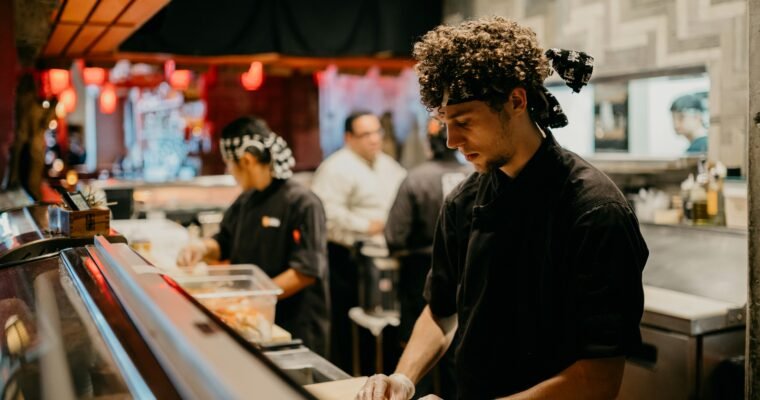
It’s 7:15pm on a Saturday. Five Chef de Parties are working five stations in a 5-star hotel kitchen in Chennai. The Saucier is reducing a veal jus and reheating thirty portions of makhani gravy in a bain-marie. The Grillardin is checking tandoor temperature for the next round of seekh kebabs. The Poissonnier is portioning pomfret for the seafood platter going out at 7:30. The Pâtissier is plating sixty desserts for a banquet that finishes at 8. The Garde Manger is rebuilding a cold buffet that’s been hit hard for the last hour. All five are CDPs. All five report to the same Sous Chef. None of them are doing the same job.
This is what every “chef de partie job description” article on the internet misses. They list duties as if every CDP does the same thing. In a real Indian hotel kitchen, the responsibilities of a CDP depend almost entirely on which station they run.
This guide breaks down what a CDP actually does — station by station, shift by shift, with monthly salary ranges by rank and city tier. It covers the classical European stations, the Indian hotel additions (Tandoor Specialist, Indian Curry CDP, Halwai) that don’t appear in standard textbooks, and the unwritten responsibilities that determine whether you get promoted to Sous Chef.
Written from working-kitchen experience leading brigades across Tamil Nadu and international hotel kitchens.
What is a Chef de Partie?
A Chef de Partie (CDP), also called a station chef or line cook, is a kitchen professional responsible for running one specific section of a professional kitchen. CDPs report to the Sous Chef, supervise one to three Commis chefs, and own the production, quality, and mise en place of their station from pre-shift setup through post-shift handover.
The word “partie” is French for “section” or “part.” That’s the whole role — you own a part of the kitchen. Within the classical brigade structure, the CDP sits below the Sous Chef and above Commis I, II, and III.
Within the CDP rank itself, there are three sub-levels in most Indian 5-star hotels:
- Demi Chef de Partie — assistant to the CDP, often running the station alone during off-peak shifts. Typically 1–2 years of CDP-track experience.
- Chef de Partie — full station owner during all shifts including peak service. Typically 3–5 years total kitchen experience.
- Senior Chef de Partie — runs the largest or most complex station, often acts as Sous Chef during the Sous’s day off. Typically 5–7 years total.
Movement between these sub-ranks usually takes 1–2 years each, depending on hotel chain and station availability.
The 5 Classical CDP Stations Found in Indian Hotel Kitchens
Indian 5-star hotels follow the classical European brigade for their Continental and Western kitchens — the same five stations Auguste Escoffier formalised in the late 1800s. Smaller standalone restaurants and cloud kitchens combine stations; large 5-star kitchens have all five plus Indian-specific additions covered later.
Saucier (Sauce CDP) — Responsibilities
The Saucier runs the sauce station, which in classical European brigade is considered the most senior CDP position. In Indian 5-star hotels, the Saucier often handles Indian gravy bases too, making this the highest-output station in many properties.
Daily duties:
- Prepare mother sauces (béchamel, velouté, espagnole, tomato, hollandaise) and their derivatives every morning
- Build stocks — chicken, vegetable, fish, brown veal — from scratch on a 4–6 hour cycle
- In Indian hybrid kitchens: prepare base gravies for makhani, kadhai, korma, and tikka masala dishes
- Reduce jus, finish sauces to order during service
- Rebuild par levels for the next service before clocking out
KPIs the Sous Chef checks at this station:
- Sauce consistency from one batch to the next (a customer who orders the same dish on Tuesday and Thursday should not notice a difference)
- Stock yield per kilo of bones used — typically 70–80% extraction
- Wastage percentage on prepared sauces — should stay under 5% for the station to hit food cost targets
- Mise en place readiness 30 minutes before service open
India-specific context: In hotels with separate Indian kitchens, the Saucier role splits — there’s a Continental Saucier and an Indian Curry CDP. In smaller hotels, one CDP covers both, which doubles the workload but is a faster route to Sous Chef because the cross-cuisine experience is rare.
Progression marker: Saucier CDPs get promoted to Sous Chef faster than other stations, because the role already requires understanding all hot-line outputs. A Saucier who can write a service-day mise en place sheet for the entire hot kitchen is six months from Sous.
Grillardin (Grill CDP) — Responsibilities
The Grillardin runs the grill station — charcoal grill, plancha, salamander, and in Indian hotels, often the tandoor as well. This station has the tightest ticket times during service because grilled and tandoor items typically go out first or as part of multi-course thalis.
Daily duties:
- Mark, sear, and finish proteins to order — steaks, chops, kebabs, tikkas, fish steaks
480–500°C for naan, 350°C for kebabs )
- Coordinate with Saucier for sauce pickup on each plated dish
- Manage the protein walk-in rotation — first in, first out, by cut and date
- Resting protocols on rested cuts, especially for thicker steaks and roasted whole birds
KPIs the Sous Chef checks:
- Order ticket times during service — grill tickets should clear in under 12 minutes for medium-rare proteins
- Consistency of doneness — temperature checks at random during service
- Protein wastage on butchery and trimming — usually targeted under 8% on whole-cut work
- Fuel cost (gas, charcoal) per cover — tracked monthly in operations meetings
India-specific context: In Indian 5-star hotels, the tandoor is often a dedicated sub-rank — Tandoor Specialist CDP — rather than part of the standard Grillardin role. This is covered in detail in the kitchen brigade system guide. Hotels with major banquet operations also run a separate Outdoor Catering Grill CDP for live counter setups.
Progression marker: Grill CDPs in Indian 5-star hotels often move into banquet or outdoor catering Sous Chef roles, because the volume management skill from peak service translates directly to large-event production.
Poissonnier (Fish CDP) — Responsibilities
The Poissonnier handles fish and seafood. This station is more prominent in coastal hotels (Goa, Kochi, Chennai, Mumbai) than in inland properties, and in many North Indian hotels, the Poissonnier role is combined with the Saucier station.
Daily duties:
- Receive and inspect fish deliveries (smell, eye clarity, gill colour, ice condition)
- Butcher whole fish — scaling, gutting, filleting, portioning — for the day’s service
- Prepare seafood-specific sauces and accompaniments
- Manage cold-chain protocols religiously, with hourly temperature logs
- Rotate stock daily — seafood has a 1–3 day shelf life even on ice
KPIs the Sous Chef checks:
- Yield percentage from whole fish — a 1kg pomfret should yield 350–450g of plated fillet
- Cold-chain temperature logs — gaps in logging trigger immediate corrective action
- Cross-contamination protocols — separate boards, knives, and gloves for raw seafood
- Wastage on butchery — under 6% for skilled CDPs working clean fish species
India-specific context: FoSTaC Basic certification is non-negotiable for Poissonniers. This station has the highest food safety risk in most kitchens, and FoSTaC documentation is the FSSAI compliance baseline. Coastal hotels also run live tank operations (lobster, crab) that fall under this CDP’s remit.
Progression marker: Poissonnier CDPs who move to Sous Chef typically do so within a coastal or seafood-specialty hotel rather than crossing into general-cuisine Sous roles. The specialisation is both a strength and a constraint.
Pâtissier (Pastry CDP) — Responsibilities
The Pâtissier runs the pastry section — desserts, breakfast pastries, breads, and in Indian banquet operations, mithai (Indian sweets) at scale. This station operates on a separate rhythm from the hot line, with longer prep cycles and earlier start times.
Daily duties:
- Plated dessert mise en place for restaurant service
- Banquet sweet production (gulab jamun in 200–500 piece batches, kheer by the gallon, halwa for live counters)
- Bread program — sourdough, dinner rolls, kulchas, naans (in pastry-managed kitchens)
- Breakfast pastry production — croissants, danishes, muffins
- Inventory management on dairy, butter, chocolate (high-cost ingredients with their own theft risk)
KPIs the Sous Chef checks:
- Plating consistency on plated desserts (especially for fine dining outlets)
- Banquet quantity accuracy — over-production above 10% triggers a wastage review
- Mise en place ready 90 minutes before banquet doors open
- Cost per portion on signature desserts, tracked monthly against menu price
India-specific context: In hotels with major banquet operations, the Pâtissier is often supported by a separate Halwai CDP (Indian sweets specialist). Five-star hotels in Delhi NCR, Hyderabad, and Lucknow particularly have full-time Halwai positions because of wedding and event volume.
Progression marker: Pastry is a parallel brigade ladder. Pastry CDP → Pastry Sous → Pastry Chef → Executive Pastry Chef. Crossing into general kitchen Sous Chef from pastry is rare and usually happens only at smaller hotels.
Garde Manger (Cold Kitchen / Larder CDP) — Responsibilities
The Garde Manger runs the cold kitchen — salads, cold appetisers, charcuterie if applicable, and the cold buffet section in banquet operations. This station is often underrated for promotion potential, which is a mistake.
Daily duties:
- Salad and cold appetiser mise en place for restaurant service
- Cold buffet setup for banquets — in 5-star Indian hotels, this can be 40+ items including chaat counters, cold cuts, salads, and dessert displays
- Charcuterie, terrines, pâtés where the property does in-house production
- Garnish prep for hot kitchen stations — herbs, micro-greens, pickled vegetables
- Cold storage temperature monitoring (separate from Poissonnier’s seafood storage)
KPIs the Sous Chef checks:
- Cold-chain logs for all cold preparations
- Buffet station setup speed (a 40-item buffet should be fully set in under 75 minutes by a CDP and two Commis)
- Garnish consistency across all stations — every plate leaving the hot kitchen has Garde Manger garnish on it
- Wastage on perishable salad ingredients
India-specific context: The Garde Manger CDP in 5-star Indian hotels often runs banquet cold sections that are more complex than the hot kitchen output, especially for wedding events with 1,000+ covers. This volume management is a direct path to Banquet Sous Chef.
Progression marker: Garde Manger CDPs are often promoted directly to Banquet Sous Chef rather than restaurant Sous Chef, because the volume and choreography skills transfer specifically to event operations.
The Indian Hotel Additions Most Articles Miss
Three CDP roles exist in Indian 5-star hotel kitchens that don’t appear in the classical European brigade. Any working chef in India will recognise these immediately. Most online job descriptions don’t cover them.
Tandoor Specialist CDP. Runs the tandoor station as a dedicated specialism. Manages dough preparation, marination cycles for kebabs and tikkas, tandoor temperature during service, and the high-output coordination that tandoor production requires during peak banquet shifts.
Indian Curry CDP. Handles the Indian gravy base production and the live curry stations during service. In hotels with both Continental and Indian outlets, this is a separate CDP from the Saucier. Specialism includes mastering the regional gravy variations — Punjabi makhani vs. Lucknowi korma vs. South Indian coconut bases.
Halwai CDP. Runs the Indian sweets section, often as part of the broader pastry team but with separate equipment, separate ingredients, and separate techniques. Ghee work, chenna preparation, sugar syrup management at different stages, and the volume production cycles for wedding banquets are all Halwai specialisms.
These three roles aren’t just regional curiosities — they exist in nearly every 5-star Indian hotel kitchen, and CDPs in these roles often progress to Sous Chef positions specialising in Indian cuisine or banquet operations.
Daily Shift Structure of a CDP — Hour by Hour
Most articles list duties as bullet points. Here’s what a CDP shift actually looks like in a typical 5-star hotel kitchen running lunch and dinner service.
Pre-shift (typically 90 minutes before service opens):
- Station setup — equipment check, fire-on for stoves, cold storage temperature logs
- Mise en place inventory — what’s prepped, what needs prepping, what came in fresh
- Pre-service briefing with Sous Chef — covers, VIP allergies, special requests, banquet handovers
- Final mise en place push with Commis chefs — last 30 minutes before doors
Service (3–5 hours depending on outlet):
- Call-and-response with the expediter at the pass
- Plating and quality control on every plate leaving the station
- Commis supervision — ensuring the Commis aren’t slowing down ticket times
- Mid-service mise en place rebuild — halfway through service, top up depleted prep
- Mistake recovery — covering for a Commis who burns a sauce, recooking a steak that came back
Post-shift (60–90 minutes after last cover):
- Closing checklist — equipment off, gas off, station deep-cleaned, walk-in temperatures logged
- Par level check for next service
- Handover notes for the next shift’s CDP — what’s prepped, what’s running low, what came back from guests
- Wastage logging — every kilogram thrown out gets recorded in the wastage book
A CDP’s shift is typically 10–12 hours, sometimes longer during banquet weekends. Two days off per week is standard in 5-star hotels; standalone restaurants often offer only one.
Chef de Partie Salary in India by Station
Monthly figures, not annual. CDP salary in Indian kitchens varies by station, city tier, and rank within the CDP grade (Demi, full CDP, Senior CDP).
| Station | Tier 1 (Mumbai, Delhi, Bangalore, Hyderabad) | Tier 2 (Chennai, Pune, Kolkata, Ahmedabad) | Tier 3 city |
| Saucier / Indian Curry | ₹38,000–55,000 | ₹32,000–46,000 | ₹26,000–38,000 |
| Grillardin / Tandoor | ₹35,000–52,000 | ₹30,000–44,000 | ₹25,000–36,000 |
| Poissonnier | ₹36,000–54,000 (coastal premium) | ₹30,000–44,000 | ₹25,000–36,000 |
| Pâtissier / Halwai | ₹40,000–58,000 | ₹34,000–48,000 | ₹28,000–40,000 |
| Garde Manger | ₹34,000–50,000 | ₹28,000–42,000 | ₹24,000–35,000 |
Rank within CDP grade:
- Demi Chef de Partie: typically the lower end of each range
- Chef de Partie: middle of each range
- Senior Chef de Partie: upper end, plus 10–15% premium during Sous absence cover
What’s included in addition to base salary in 5-star hotels:
- Service charge tip-out (typically ₹3,000–8,000/month depending on hotel and outlet)
- Staff meals during shift
- Uniform and laundry
- Provident Fund and gratuity per Indian labour law
- Health insurance (varies by chain)
For full salary context across the brigade ranks from Commis to Executive Chef, see the chef salary in India 2026 guide.
How to Progress from CDP to Sous Chef
Time-in-rank reality for CDP-to-Sous progression in Indian 5-star hotels: typically 3–5 years as a full CDP before serious Sous consideration. Demi-CDP time doesn’t fully count.
What gets a CDP promoted:
Cross-station experience. CDPs who have run only one station rarely get Sous Chef offers. Sous Chefs need to oversee all stations, which means having worked at least three of them. Aim for two-year rotations across stations starting from your second CDP year.
KPI ownership. Sous Chefs are evaluated on food cost percentage, labour cost, and Commis training quality. CDPs who already track these metrics for their station — without being asked — become obvious promotion candidates. Start tracking your station’s food cost in a personal logbook.
Training Commis effectively. The most undervalued promotion criterion. A CDP whose Commis chefs get promoted to Demi-CDP smoothly is a CDP who can run a Sous-Chef-level team. Sous Chefs notice.
Banquet management. CDPs who can run a 500-cover banquet station setup and breakdown — without the Sous Chef micromanaging — are demonstrating Sous-level autonomy.
Compliance ownership. FoSTaC tracking, FSSAI documentation, and HACCP logs that stay current without reminders signal operational maturity.
For a full year-by-year career roadmap from kitchen trainee to Head Chef, see the 10-year chef career path guide.
CDP Responsibilities That Are NOT in the Job Description
Every job description on the internet covers the formal duties. Here’s what actually fills a CDP’s day that doesn’t appear in any HR-written JD.
Training Commis chefs. Most 5-star hotels have no formal Commis training program. The CDP teaches everything — knife skills, technique, mise en place discipline, kitchen etiquette. This is unwritten, untimed, and continuous. CDPs who skip this end up with Commis who slow down service.
Covering for absent CDPs at adjacent stations. When the Grillardin calls in sick, the Saucier covers. When the Garde Manger’s Commis is on leave, the Pâtissier sends one of theirs over. There’s no rota for this. It’s understood.
Banquet event setups outside the main kitchen rota. Outdoor live counters at weddings, off-property catering events, breakfast buffet duty when the rostered CDP can’t make it. CDPs are the kitchen’s flex capacity, and banquet weeks involve 60+ hour shifts.
Compliance ownership for the Commis chefs under them. Tracking FoSTaC certification expiry dates for the Commis on the station. Ensuring the team’s medical fitness certificates are current. This rolls up to the CDP because the Sous Chef doesn’t have time to track it per-Commis.
HR-side duties. Leave coordination across the station’s three Commis. Staff meal coordination during banquet weeks. Cleaning rota enforcement. Dispute mediation between Commis chefs. Nobody trains a CDP for any of this.
The unspoken first responsibility — being there. Indian hotel kitchens run on presence. If you’re in the kitchen 30 minutes early and you stay 30 minutes late, you become the CDP the Sous Chef trusts. If you’re on time and out the door, you stay a CDP for longer.
Frequently Asked Questions
What is the difference between a Chef de Partie and a Demi Chef de Partie?
A Demi Chef de Partie is the assistant to the CDP, typically with 1–2 years of station experience. A full Chef de Partie owns the station independently across all shifts including peak service. The promotion from Demi to full CDP usually takes 1–2 years and depends on station-ownership readiness rather than time alone.
How many years does it take to become a Chef de Partie in India?
Typically 4–6 years total kitchen experience. Most CDPs come up through Commis III → Commis II → Commis I → Demi CDP → CDP, with each rank taking 1–2 years. IHM graduates with 3-year diplomas can shorten this slightly; direct-entry chefs without formal education take longer.
Which CDP station has the highest salary in India?
Pâtissier (pastry) and Saucier typically pay slightly higher than other stations in 5-star Indian hotels — Pâtissier because of the specialised skill set, Saucier because the role often crosses into Indian curry production. Senior Pastry CDPs in Delhi NCR can reach ₹58,000/month, the highest band among CDP roles.
Can a CDP become Sous Chef without working in a 5-star hotel?
Yes, but the path is harder. Standalone fine-dining restaurants and cloud kitchen brands do promote CDPs to Sous Chef, often faster than 5-star hotels because the brigade is smaller. The trade-off: 5-star Sous experience is more transferable across the industry.
What does “partie” mean in Chef de Partie?
“Partie” is the French word for “section” or “part.” A Chef de Partie is literally the chef of a section — meaning the role is defined by which section they own (sauce, grill, pastry, etc.) rather than by a generic kitchen function.
Is Chef de Partie higher than Sous Chef?
No. The Sous Chef is one rank above the CDP. Within the brigade, the order from senior to junior is: Executive Chef → Chef de Cuisine → Sous Chef → Chef de Partie → Demi Chef de Partie → Commis I → Commis II → Commis III.
Conclusion
Chef de Partie responsibilities aren’t a single job description. They’re a job description that changes depending on which station you run, which kind of kitchen you’re in, and where in the CDP rank you sit. A Saucier’s day doesn’t look like a Pâtissier’s day. A 5-star hotel CDP’s responsibilities don’t match a cloud kitchen CDP’s. A Demi-CDP doesn’t yet own what a Senior CDP owns.
The chefs who move from CDP to Sous Chef aren’t the ones who tick off the formal duties best. They’re the ones who own the unwritten responsibilities — Commis training, cross-station coverage, compliance, banquet flex, presence. That’s the actual evaluation criteria. Knowing this early in your CDP years saves you a year or two of waiting for promotions that aren’t coming.
For working chefs benchmarking themselves: track your own station’s KPIs in a personal logbook. Cross-train into a second station within your first two years. Take on Commis training as if it’s part of your formal job. The CDPs who do these three things consistently become Sous Chefs in 3–4 years instead of 5–6.
To track your station’s food cost percentage and recipe yields, the recipe cost calculator is built specifically for Indian kitchen operations and supports both Continental and Indian gravy costing.

Leave a Reply