

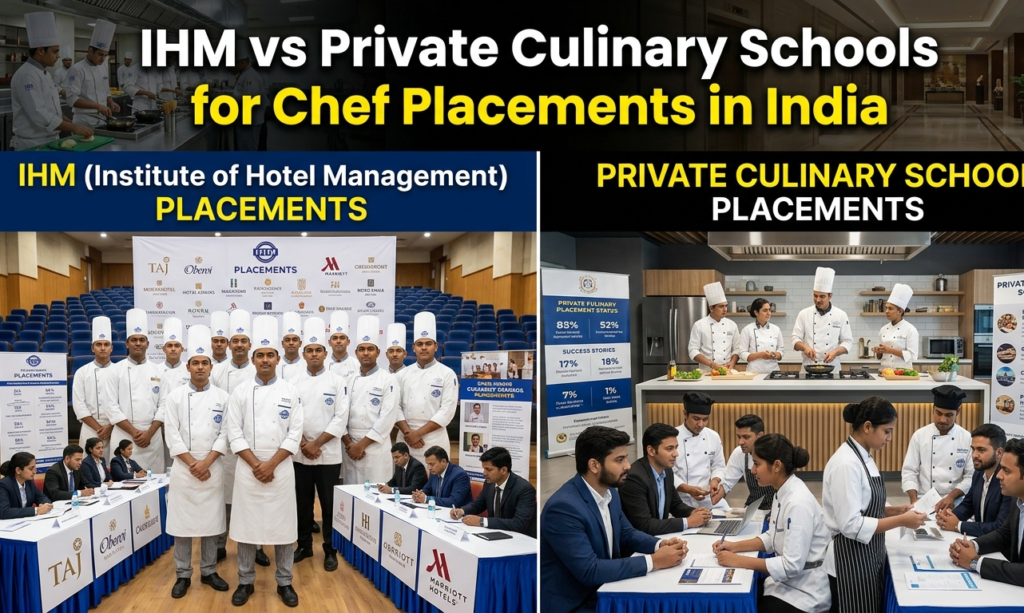
For chef placement readiness in India, IHM is usually the safer route if you want a broad hospitality base, a standardised academic structure, and an established campus-recruitment system. NCHMCT’s B.Sc. in Hospitality and Hotel Administration runs for six semesters over three years, and IHM Pusa says more than 60 companies visited for recruitment in the 2024–25 session. Those are useful signals of structure, not a promise of placement.
Most pages on this topic are written like admission counselling. A working kitchen professional needs a different answer: which route builds stronger chef placement readiness, who benefits from each path, and what should be checked before money is spent.
The IHM route sits inside a national structure. NCHMCT’s current material shows a three-year, six-semester B.Sc. (HHA) recognised by JNU, with industrial training built into the calendar. The NCHM JEE 2025 brochure lists 21 central IHMs, 33 state IHMs, one PSU-owned IHM, and 25 private institutes within the NCHMCT-affiliated network. That gives recruiters a familiar system.
How the IHM route works in India
The IHM path is stronger than many students realise because it is not just one college label. It is a system. NCHMCT’s admission page says the B.Sc. in Hospitality and Hotel Administration is a three-year, six-semester full-time programme recognised by JNU and designed for supervisory responsibilities in hospitality. The academic calendar also shows 17 weeks of industrial training in Semester III for one group and 17 weeks again in Semester IV for the other group. That means exposure to live industry environments is part of the structure.
For chef placements, that structure matters in three ways. First, the route usually builds wider operational literacy. Students are not trained only around food production; they also see service, rooms, controls, and hospitality systems. That helps in Indian hotels because recruiters value kitchen candidates who understand the wider operation.
Second, recruiters already understand the model. The IHM Pusa placement page says more than 100 positions were offered and more than 60 companies visited in the 2024–25 session. That is one campus, not the whole ecosystem, but it shows the kind of institutional placement process a mature IHM campus can run.
Third, the route gives flexibility. A student may start with a chef goal and later discover a stronger fit in pastry, banquets, institutional catering, or another hospitality track. IHM keeps that option open.
What private culinary schools usually offer
Private culinary schools can be the better route when the programme is genuinely kitchen-led and industry-linked. The attraction is focus. A strong private school can move faster, offer smaller-batch practical training, and build a sharper identity in culinary arts, pastry, or bakery than a broad hotel-management course.
IIHM’s Delhi campus is one example of the private side marketing hospitality, culinary arts, and patisserie options while also highlighting internships and city-based exposure. That does not prove every private school performs the same way. It proves the category can be structured, but the quality gap between institutes can be wide.
For chef placements, three checks matter more on the private side than on the IHM side. Check who actually recruited recently, not who appears in a logo strip. Check whether internships were kitchen-facing. And check whether the programme produces food-production entry roles rather than generic hospitality openings. A strong private school can outperform a weak campus on job readiness. A weak private school can look premium and still convert poorly.
The chef placement readiness gap most comparison pages miss
This is the gap competitors are not handling well.
Most comparison pages treat placements as a brochure metric. A chef in India should look at placement readiness instead. Placement readiness means the candidate can step into a commis-level environment and function with less correction.
For a chef candidate, placement readiness has six parts: kitchen repetition, industrial training quality, faculty credibility, recruiter fit, city advantage, and student discipline. That is a better filter than highest package or brand name.
This changes the entire comparison. Choose IHM when you want system familiarity, recruiter recognition, broad hospitality grounding, and a more standardised route. Choose a private culinary school when it can prove deeper kitchen immersion, stronger chef mentorship, and relevant recruiter access for the segment you want. If it cannot prove those things, the private option becomes a risk premium without a clear return.
IHM vs private culinary schools in India: head-to-head
| Factor | IHM route | Private culinary school route | What it means |
|---|---|---|---|
| Curriculum structure | Standardised, broad hospitality coverage | Varies by institute; can be highly specialised | IHM is safer when you want recruiter familiarity |
| Industrial training | Built into the NCHMCT academic structure | Depends on institute design and partner network | Private schools must prove internship quality |
| Recruiter recognition | Stronger at known campuses | Strong only where institute ties are current | Ask for recent role types, not historic logos |
| Kitchen depth | Broader base; kitchen depth depends on use | Can be deeper and earlier in focus | Better for kitchen-only candidates if quality is real |
| Career flexibility | High | Depends on programme breadth | IHM gives more room to change direction |
| Quality consistency | More predictable, though campuses vary | Highly uneven across the market | Due diligence is mandatory on the private side |
| Cost-to-opportunity fit | Often stronger when recruiter access is real | Depends heavily on school quality and city | Weak private schools can become expensive mistakes |
If you need a safer default with broad acceptance, pick the strongest IHM campus you can realistically access. If you want a private school, demand evidence that it produces kitchen-ready candidates and relevant recruiter access.
[INTERNAL LINK: NCHM JEE strategy for chef-track students → target article topic]
When IHM is the stronger route
Choose IHM first when you want a broad hospitality base, a recognised system, and campus credibility recruiters already understand. It also suits candidates who are not yet fully certain whether they want hot kitchen, pastry, bakery, banquets, or a wider hotel pathway.
IHM is also stronger when the private options you are comparing cannot answer four questions clearly: Who recruited in the last cycle? Which roles were kitchen-facing? How were internships assigned? Which chef faculty have current operational credibility? If those answers are weak, the private option is not stronger just because it sounds more specialised.
When a private culinary school is the stronger route
Choose a private culinary school when the institute can prove deeper kitchen immersion, credible chef-led training, and relevant recruiter or internship access for the segment you want. This route can be stronger for students who already know they want food production, pastry, bakery, or restaurant-focused careers and do not need a broad hotel-management identity first.
What you should not do is assume every private school is specialised just because it says “culinary” in the prospectus. Ask for kitchen hours, training infrastructure, internship model, chef faculty profiles, and actual entry-level roles students moved into.
[INTERNAL LINK: kitchen internship checklist for Indian chef students → target article topic]
A practical decision framework for working chefs advising juniors
If a junior in your kitchen asked where to study, the best answer would not be ideological. It would be diagnostic.
Use this five-question filter before choosing:
1. Does the programme build kitchen-ready repetition or just classroom coverage?
2. Are internships actually kitchen-facing and relevant to the segment the student wants?
3. Which recent recruiters are real, and what roles did students enter?
4. Are the chef faculty operationally credible?
5. Is the cost justified by the likely opportunity, not by brochure language?
The bottom line is this: for chef placements in India, IHM is the stronger default route in most cases because the structure is visible and recruiters understand it. A private culinary school becomes the better choice only when it can prove stronger kitchen depth and clearer role conversion for the student’s target segment.
[INTERNAL LINK: commis chef salary in India by hotel segment → target article topic]
Red flags to check before you commit
Do not choose either route without document-level proof. On the IHM side, campus quality still varies, so look beyond the system name and check training culture, city location, and actual recruiter relevance to food production. On the private side, be stricter. Ask for the current year’s recruiter list, internship structure, training-kitchen photos, faculty profiles, and recent entry-level roles taken by graduates.
Three red flags should slow the decision immediately. One, the institute talks about “100% placement” but cannot show role types, recruiter names, and the batch size behind the claim. Two, the school highlights international branding but gives weak clarity on kitchen hours and industrial training. Three, the sales team talks more confidently than the chef faculty.
A serious chef candidate should also ask where alumni actually started. Commis? Bakery trainee? QSR production? Banquet kitchen? Management trainee? That answer tells you more than a generic placement promise.
FAQ
Which is better, hotel management or culinary arts?
Hotel management is better when the candidate wants broad hospitality mobility, while culinary arts is better when the goal is a kitchen-first career. For chef placements in India, the right choice depends on whether the programme builds real kitchen repetition, industrial training quality, and recruiter access for food production roles.
Can I become a chef by doing hotel management?
Yes. Many chefs in India start through hotel-management routes, especially the IHM path, because those programmes include food production exposure, industrial training, and campus recruitment systems. The key issue is not the label alone. It is whether you use the course to build kitchen depth, internships, and food-production role readiness.
Is culinary school worth it in India?
Culinary school is worth it in India when the programme gives strong kitchen practice, credible chef faculty, relevant internships, and realistic recruiter access. It is not worth it when the school sells branding without proving kitchen intensity or role conversion. The value comes from training quality, not from brochure language.
Which course is best for a chef?
The best course for a chef is the one that produces kitchen readiness for the segment you want to enter. In India, an IHM-linked hospitality route is usually safer for broader recruiter recognition, while a strong private culinary programme can be better when it offers deeper food-production or pastry focus.
How much do chefs get paid in hotels?
Hotel chef pay in India varies sharply by city, brand tier, department, and role level. Entry roles such as commis positions usually depend more on training quality and hotel type than on course branding alone. Students should compare likely first-role opportunities, training quality, and growth path rather than chasing one salary headline.
Are chefs paid well in India?
Chefs can be paid well in India, but pay improves with role level, property tier, consistency, and specialisation. Early career pay is usually modest compared with the physical and mental demand of kitchen work. The better question is which training route improves long-term growth, not which brochure suggests the highest starting package.
What is one disadvantage to culinary school?
One disadvantage is overspecialisation without enough industry proof. A student can finish with enthusiasm and decent practical exposure but still struggle if the school has weak internships, weak recruiter links, or limited recognition in the market. That is why private culinary programmes must be checked more carefully than their branding suggests.
What is the average salary of a hotel management student who wants to be a chef?
There is no single average that stays reliable across India because starting pay changes by city, hotel segment, kitchen type, and internship quality. A student aiming to become a chef should evaluate likely entry roles, training environment, and progression speed rather than rely on one average figure from a comparison article.
| Reviewer note: The article intentionally discusses placement readiness, internship quality, recruiter fit, and decision criteria. It does not promise outcomes or repeat unverifiable placement claims. |
Author Bio: Chef Anand is the founder of ChefAnandhub and reviews career and kitchen-operations content for working chefs in India.

Leave a Reply